A] Powder Coating:
Powder coating is the process of coating an object with a fine powder so that the surface of the object is protected from rust, scratches, and wear & tear. This process includes completely covering the object with the powder and heating it in an oven, causing the powder to melt and form a smooth, hard, and durable layer. This method is generally used on metal products, like automobile parts, appliances, machines, outdoor furniture, and other objects that are exposed to the environment.
Powder coating is quickly replacing the traditional liquid painting since it is more environmentally friendly, produces less waste, and contains no harmful solvents.
One of the critical processes that ensures the success of a powder coating system is the fluidisation process, which relies on specialised fluidising sheets for powder coating systems.
Looking for high-quality porous plastic fluidisation sheets?
Find the best porous plastic products for the scent industry.
B] Fluidisation:
Fluidisation can simply be defined as the process of making a solid powder behave like a fluid when suspended in air or gas. In powder coating, fluidisation is used to prepare the powder for spraying. When air is blown through the powder, which is placed in the hopper, it lifts and separates the powder particles, causing them to move freely like a liquid. This process is facilitated by a fluidisation plate/fluidisation membrane for powder coating, ensuring even air distribution.
The fluidisation process has several important functions in powder coating:
1. Smooth Powder Flow—Fluidisation makes powder flow like a liquid, allowing it to move steadily through the system. This ensures a consistent supply to the spray gun for uniform coating application.
2. Prevents Clumping—By constantly flowing air or gases through a bed of fine powder, fluidisation prevents the powder from sticking together and forming clumps. This reduces blockages in the spray gun and keeps the powder coating process smooth and uninterrupted.
3. Improved Coating Quality—Fluidisation results in even and uniform powder distribution, which helps to achieve a high-quality finish. It prevents uneven thickness, enhancing the appearance, durability, and overall performance of the coating.
4. Better Powder Pickup—Fluidised powder is easier for the spray gun to pick up. The evenly suspended particles enhance the efficiency of powder transfer from the hopper to the spray gun, improving the efficiency and ensuring better coating.
5. Reduced Waste—With steady powder flow and fewer clogs, fluidisation helps reduce overspray and material loss. This results in more efficient use of powder and lowers overall production costs.
6. Enhanced Control—Fluidisation provides consistent and predictable powder behaviour. This offers operators better control over the spraying process, providing more accurate, repeatable, and high-quality coating results.
Now, let’s explore the fluidisation sheet. It is one of the most important components required for completing the fluidisation of a powder:
C] Fluidisation Sheet
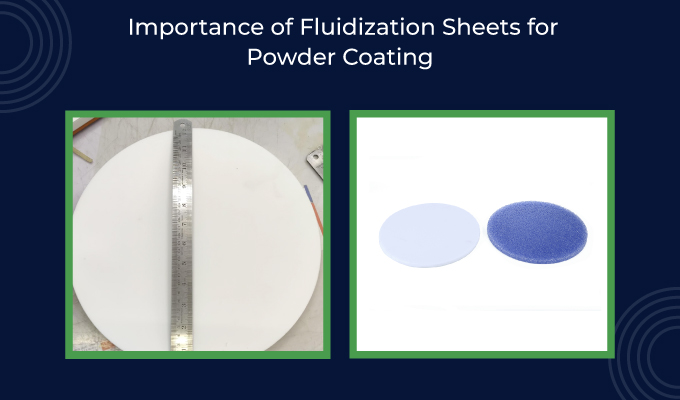
A porous fluidisation sheet for powder flow, or fluidisation plate, is usually made from porous plastic. It is used in powder coating hoppers to ensure that air is evenly supplied to the powder, guaranteeing optimal fluidisation of the powder.
Traditional fluidisation sheets and plates were often made from sintered metal or perforated steel with a fluidisation fabric for powder coating overlay. However, these fluidisation sheets had severe limitations:
- Metal Plates—Heavy, expensive, and prone to corrosion
- Steel with Fabric Overlays—Heavy, expensive, requires regular maintenance, and is prone to clogging
Over the years, porous plastic has been recognised universally as the best material for a fluidisation sheet.
D] Porous Plastic Fluidisation Sheet
Porous plastic fluidisation sheets or plates are rigid, engineered sheets made from polyethene, polypropylene, or other polymeric materials. These plates are sintered to form a uniform matrix of interconnected pores, allowing for the controlled and even distribution of air across the sheet’s surface. As a leading sintered porous plastic fluidisation plates manufacturer in India, Sansuk Industries specialises in producing high-quality fluidisation solutions that meet diverse industrial requirements across various sectors.
The benefits of a porous plastic fluidisation sheet or porous plastic fluidisation plate in powder coating systems are as follows:
1. Uniform Pore Structure – The porous plastic sheets have evenly distributed microscopic pores and an interconnected porous network, allowing consistent airflow across the entire sheet. This ensures smooth and uniform fluidisation of powder, preventing uneven flow or clumping. It leads to more consistent powder delivery to the spray gun and improves overall coating quality.
2. Chemical Resistance—Materials like polyethene and polypropylene are highly inert and resist chemicals commonly found in coating powders. This allows the porous plastic fluidisation sheet to last longer without degrading or reacting, making it ideal for harsh industrial environments and reducing the frequency of maintenance or replacement.
3. Durable and Rigid—Porous plastic sheets maintain their shape and performance under pressure, vibration, and temperature variations. Their toughness and structural stability ensure reliable fluidisation during extended operation, contributing to a more dependable and consistent powder coating process in industrial settings. Given these major performance requirements, Sansuk Industries operates as a trusted sintered porous plastic sheets manufacturer and supplier in India. Moreover, they are delivering these robust solutions to support various industrial powder coating applications.
4. Porosity—The porosity of fluidisation sheets can be customised to suit different powder types and application needs. Custom porosity ensures optimal airflow for the specific powder used, enhancing fluidisation efficiency and coating consistency across a wide range of products and materials.
5. Lightweight and Non-Metallic—Being lightweight and corrosion-resistant, porous plastic sheets are easy to handle and install. They do not rust or react with powders, making them suitable for sensitive or reactive environments. Their non-metallic nature also reduces the risk of static interference in electrostatic powder coating. These characteristics make porous plastic sheets the best fluidisation sheets for powder coating machines, particularly in applications where material compatibility and operational efficiency are paramount.
6. Eco-Friendly – Efficient powder usage and reduced overspray lead to less environmental waste. Since porous plastic fluidisation supports cleaner and more controlled powder delivery, it helps maintain eco-friendly coating operations with minimal impact on the environment and safer working conditions.
7. Customisation – Porous plastic fluidisation sheets are highly customisable to any shape and size. This is highly beneficial for hoppers that are not of standard sizes. The standard sizes for a fluidisation sheet are:
- Square – Length 1 feet x Breadth 1 feet x Thickness 10 inches
- Round – Diameter 1 feet x Thickness 10 inches
Since the porous plastic fluidisation plate is of such vital importance in the powder coating system, the following factors should be taken into consideration before choosing the porous plastic fluidisation plate. Sansuk Industries, a leading sintered porous plastic products manufacturer in India, recommends careful evaluation of these critical specifications.
- Pore Size: The pore size of porous plastic sheets is typically between 10 and 100 microns, depending on the powder type, powder size, and air pressure requirements.
- Thickness: The thickness of the fluidisation plate varies between 2 mm and 10 mm. The thickness must be sufficient to handle the required airflow without deformation.
- Airflow Rate: Determined by the powder’s density and particle size; the fluidisation plate must be engineered to sustain the optimal pressure drop
- Geometry and Mounting: The porous plastic fluidisation plates must fit securely in hoppers such that they do not move during the fluidisation process.
Looking for high-quality porous plastic fluidisation sheets?
Find the best porous plastic products for the scent industry.
Conclusion
In conclusion, fluidisation sheets, especially those made from porous plastic, are essential to achieving consistent, high-quality powder coating results. Their uniform airflow, durability, chemical resistance, and customisability make them the preferred choice across industries. By investing in the right fluidisation solution, manufacturers can improve efficiency, reduce waste, and enhance coating performance. Sansuk Industries continues to lead as a trusted manufacturer of porous plastic fluidisation sheets, delivering advanced, reliable, and eco-friendly solutions tailored to diverse industrial needs. Contact Sansuk Industries for any requirements or queries about porous plastic fluidisation sheets.

FAQ's
What is used to produce fluidisation sheets?
Fluidisation sheets consist of porous plastic materials, such as polyethene and polypropylene. Sintered metal and steel perforated with fabric overlays were the traditional materials used, but porous plastic is now generally used.

sansuk
What is used to produce fluidisation sheets?
Fluidisation sheets consist of porous plastic materials, such as polyethene and polypropylene. Sintered metal and steel perforated with fabric overlays were the traditional materials used, but porous plastic is now generally used.
sansuk
Are fluidisation sheets friendly to the environment?
Yes, porous plastic fluidisation sheets are friendly to the environment. They facilitate effective use of powder and minimise overspray and wastage to the environment. In addition, they facilitate cleaner delivery of powder and ensure safer working conditions with less strain on the environment.
sansuk
What are the considerations to be taken while choosing a fluidisation sheet?
Take into account pore size (10-100 microns), thickness (2-10 mm), and airflow rate depending on powder density and particle size. One may also consider geometry for safe hopper mounting and special orders for non-standard hopper sizes.
sansuk